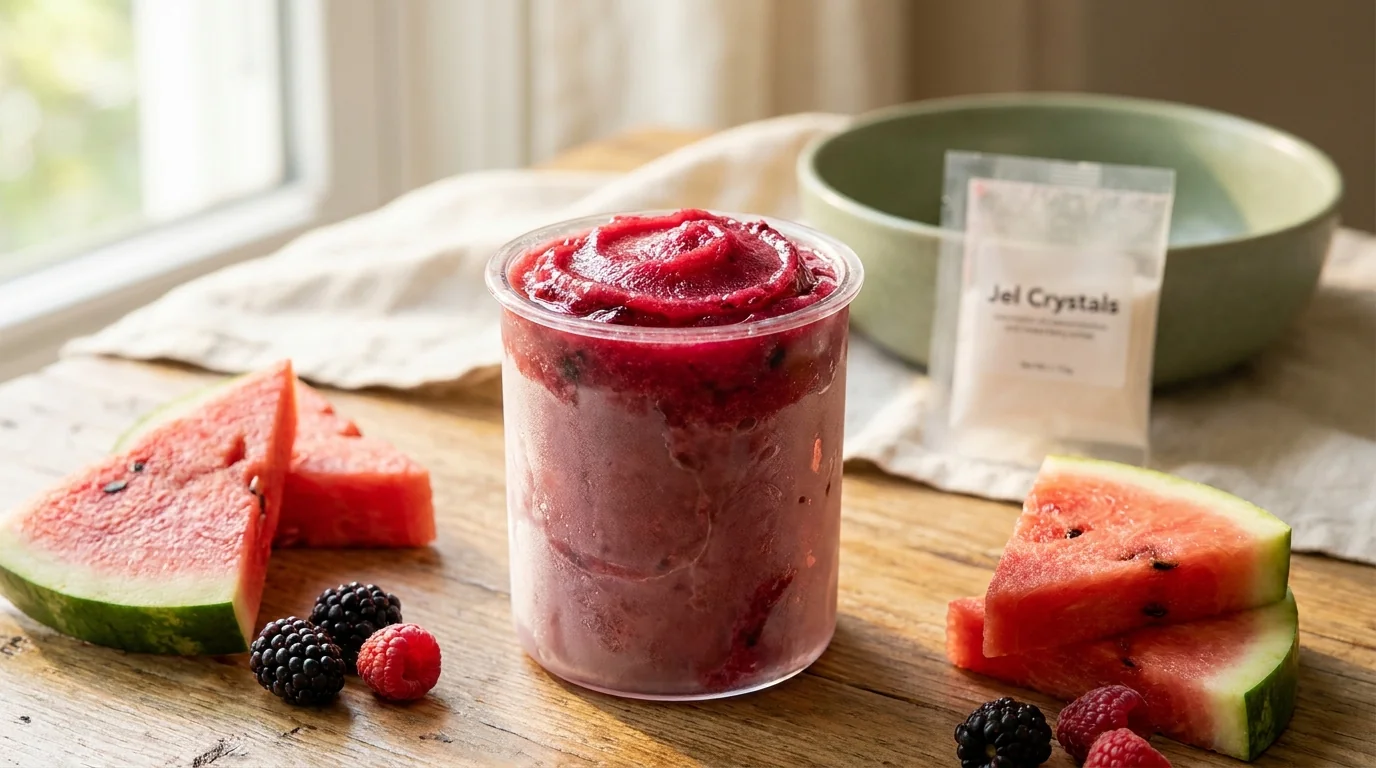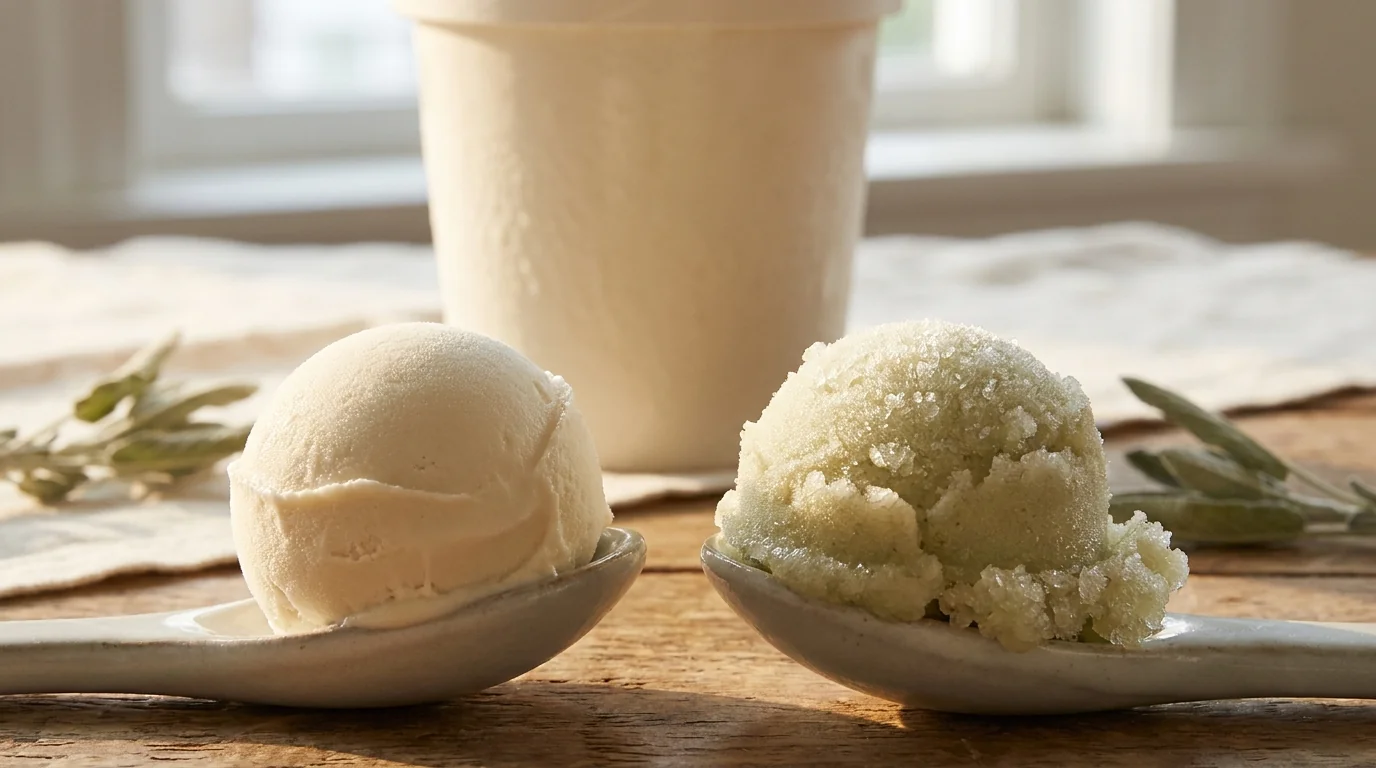
Sugar-free sorbet freezes rock-hard because sugar normally lowers the freezing point and keeps ice crystals small. Fixes: build the base on fruit juice rather than water so the fruit's own natural sugar keeps doing the antifreeze work, use allulose (best) for any added sweetness, stabilize with Simply Desserts Unflavored Jel, respin, and pick naturally-sweet, lower-water fruit. Pineapple works because it is sweet and acidic.
This is the tightly-focused deep dive on the sugar-free freezing-point problem. If you want the full jel-crystal fruit sorbet method start to finish, that lives in our Ninja Creami sorbet guide, which is the parent to this page. Here we zoom in on the one thing that trips up almost every low-sugar and keto Creami sorbet: what happens when you take the sugar out.
Why sugar-free sorbet freezes rock-hard (the science)
Sugar does two jobs in a sorbet, and only one of them is sweetness. The other is that sugar dissolved in the water lowers its freezing point, an effect called freezing-point depression. In a normal sorbet, all that dissolved sugar means a big chunk of the water never fully freezes solid at freezer temperature, so the sorbet stays soft enough to scoop and the ice crystals that do form stay small.
Take the sugar out and you strip away that antifreeze. Now your base is mostly plain water with fruit flavor in it, and plain water freezes hard and fast into large, sharp ice crystals. When the Ninja Creami blade shaves through that, it produces the coarse, icy, powdery texture you were trying to avoid, exactly the icy result covered in our Ninja Creami icy fix guide. So the honest starting point is this: no stabilizer, no trick and no respin fully replaces sugar's antifreeze effect on its own. The winning approach layers three fixes together.
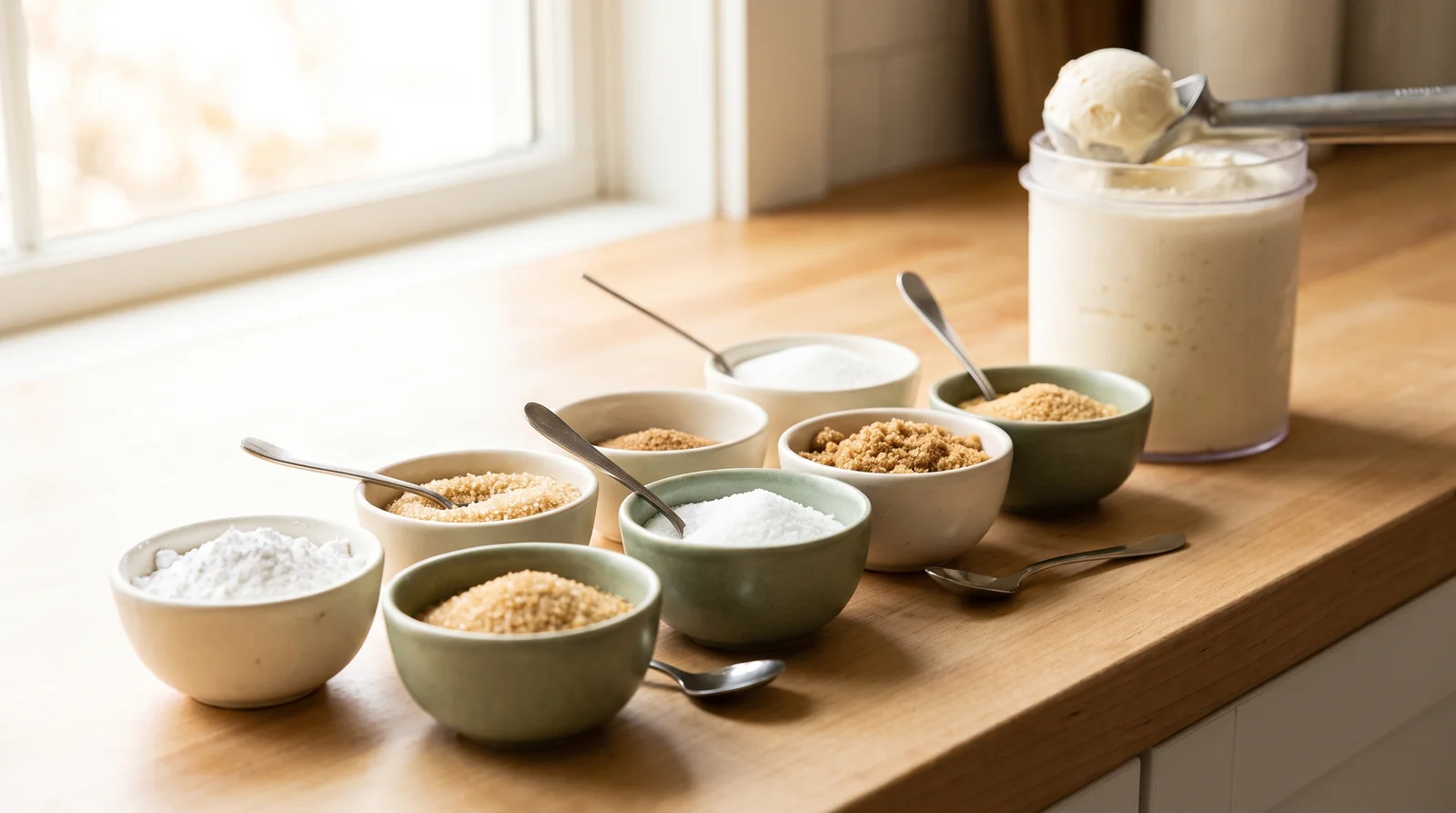
Best sugar-free sweetener for sorbet (allulose vs erythritol)
The single biggest lever is which sweetener you choose, because some sugar-free sweeteners keep more of sugar's antifreeze effect than others.
| Sweetener | Freezing behavior | Best use in sorbet |
|---|---|---|
| Allulose | Lowers the freezing point much like sugar, so the base stays soft and scoopable. Does not recrystallize. | The pro pick as the main sweetener for texture. |
| Erythritol | Sweetens cleanly but freezes harder than allulose and can recrystallize into a grainy, icy set. | Fine in small amounts or alongside allulose, better as part of a stabilizer than the whole sweetener. |
| Glycerin (vegetable glycerine) | A humectant that softens the freeze. A teaspoon or two per pint keeps sorbet from setting brick-hard. | A small texture helper, not a sweetener. Do not overdo it. |
| Stevia / monk fruit (alone) | Intensely sweet in tiny amounts, so they add zero bulk and zero antifreeze effect. | Great for flavor, useless for texture on their own. Pair with allulose. |
The takeaway: reach for allulose as your main added sweetener when texture matters, because it does the most to mimic sugar's antifreeze effect. Erythritol is a clean, popular sweetener (it is what Simply Desserts uses to sweeten its flavoured Jel Desserts and Instant Puddings), but on its own it freezes harder, which is exactly why allulose is the texture pick for a sugar-free sorbet. Worth knowing for this recipe: the Unflavored Jel we use as the stabilizer below is not sweetened at all, so it stays out of the freezing-point argument entirely. Want the full breakdown of every sweetener option for the Creami? Our Ninja Creami sweetener guide compares them side by side.
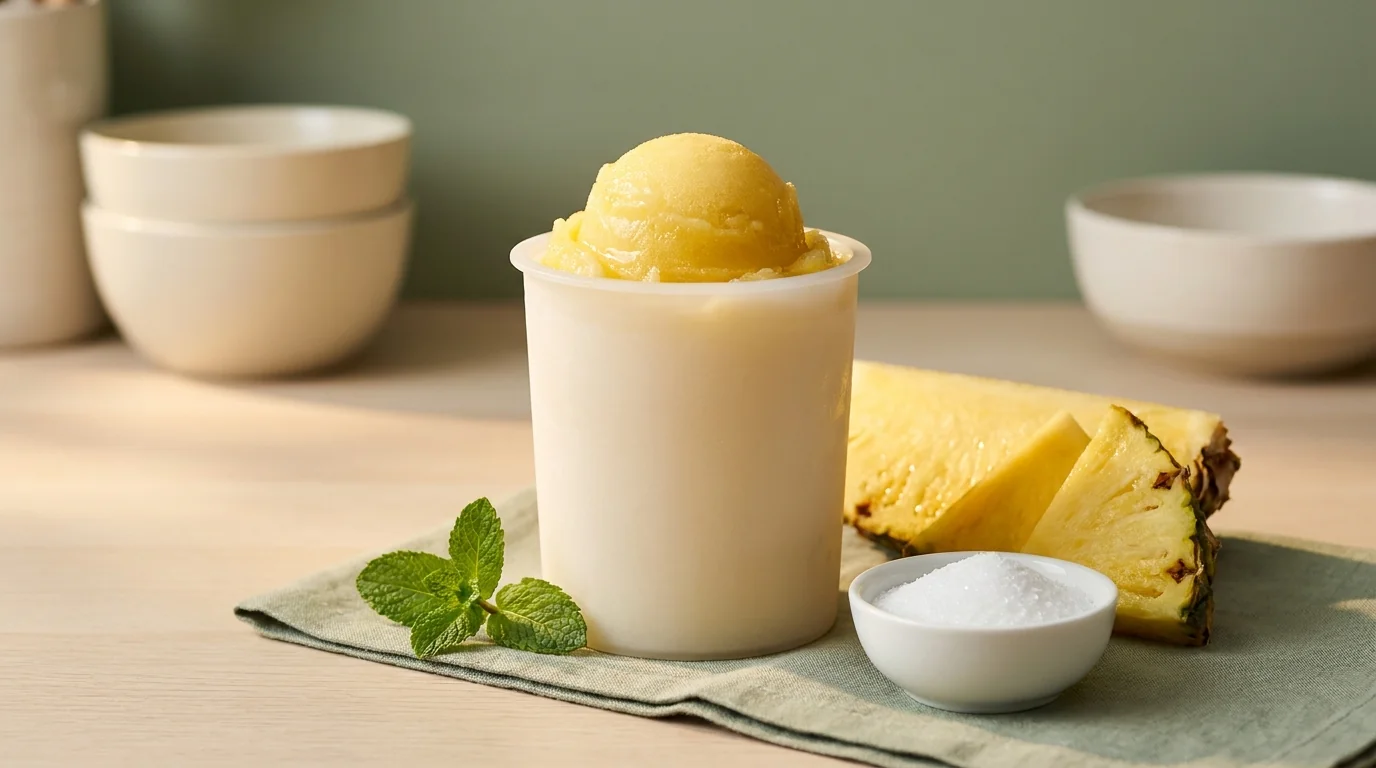
The pineapple sorbet formula (sugar-free)
Pineapple is the flagship fruit for sugar-free sorbet for two reasons: it is naturally sweet, so it still tastes like a treat with far less added sweetener, and it is acidic and full-flavored, so the taste stays bright even when you dial the sweetness down. It is also less watery than melon, which means fewer large ice crystals to begin with.
The stabilizer here is Simply Desserts Unflavored Jel, a neutral, unsweetened carrageenan jel base sold specifically so you can add your own fruit juice. That is exactly what a sorbet base is. We follow the method printed on the package, with pineapple juice standing in for the water, and we do not cut the packet down: carrageenan has to be hydrated in boiling liquid to set, so partial-packet guesswork is how you end up with a pint that never sets at all.
The full jel sorbet method start to finish lives on the parent Ninja Creami sorbet guide. Here it is applied to a sugar-free pineapple pint:
- Dissolve the jel in cold juice. Pour a packet of Simply Desserts Unflavored Jel into 1/3 cup of cold pineapple juice and stir until dissolved.
- Add boiling juice. Stir in 1 1/3 cups of boiling pineapple juice. This is the step that actually hydrates the carrageenan, and it is not optional. Sweeten with allulose to taste while the mixture is hot so it dissolves cleanly, and add a squeeze of lime to lift the flavor without adding sugar.
- Fill the pint. Pour into the Creami pint up to the MAX fill line, no higher. Our Ninja Creami fill line guide explains why overfilling wrecks a spin.
- Cool, set, then freeze. Let it cool at room temperature, then refrigerate. The jel sets in 60 minutes. Freeze the pint flat for a full 24 hours.
- Spin and respin. Run the Sorbet setting. If it comes out crumbly or powdery, add a splash of liquid to the surface and run a Re-Spin. Sugar-free bases often need one or two respins, which is normal.
Taste and adjust sweetness before freezing, never after, because a frozen pint is far harder to fix.
Why juice, not water, is doing the real work
This is the part that ties the whole page together, and it is worth being blunt about. Simply Desserts Unflavored Jel is genuinely unsweetened: its Nutrition Facts panel lists 0g total sugars, 0g added sugars and 0g erythritol. It contributes structure and nothing else. So the jel is not what keeps this sorbet scoopable, and it is not pretending to be.
What keeps it scoopable is the pineapple juice. Fruit juice carries the fruit's own natural sugars, and those sugars depress the freezing point exactly the way table sugar would, because freezing-point chemistry does not care whether the sugar came from a bag or from a pineapple. Make the same jel with water instead of juice and you have proved the point the hard way: no dissolved sugar, no antifreeze, and the pint freezes into an ice brick that the Creami will shave into powder. Sugar-free here means no added sugar, not no dissolved solids, and that distinction is the entire reason this recipe works.
Stabilizers that fix icy sugar-free sorbet
A stabilizer will not lower the freezing point (the dissolved sugar in your juice does that), but it does the second half of the job: it keeps ice crystals small so the sorbet spins smooth instead of shattering.
Simply Desserts Unflavored Jel. This is the right stabilizer for a fruit sorbet, and it is the one we build the method above around. It is a neutral, unsweetened, plant-based jel base set with carrageenan, a seaweed-derived plant gum (not gelatin, and not agar). Carrageenan builds a light gel network that traps moisture more evenly, so fewer large ice crystals form and the pint spins into a ribbon instead of shattering. Its panel is sugar-free across the board (0g total sugars, 0g added sugars, 0g erythritol), it is certified gluten-free and Kosher certified by the Circle K Organization, and because it is plant-based and dairy-free the whole sorbet stays vegan. Being unflavoured is the point: it disappears into the pineapple instead of fighting it.
Why not a flavoured Jel Dessert? The flavoured Jel Desserts (strawberry, orange, lime) are the same carrageenan family and are excellent as jello-style desserts, but they are flavoured and sweetened with erythritol and stevia. In a pineapple sorbet that means a competing flavour plus erythritol, which freezes harder than allulose. For a fruit sorbet, reach for the Unflavored Jel and let the fruit be the flavour.
One method note worth repeating: carrageenan needs boiling liquid to hydrate. Stirring jel powder into a cold puree and hoping is not the product's method, and it is the most common reason a jel-stabilized pint comes out of the freezer no better than plain frozen fruit.
Sugar-free doesn't mean flavour-free (mix-in honesty)
Here is where a lot of "sugar-free" recipes quietly cheat. A pineapple sorbet sweetened only with allulose or erythritol genuinely is sugar-free (aside from the fruit's own natural sugars). But the moment you fold in candy pieces, cookie chunks, chocolate chips or a swirl of syrup, it is not sugar-free anymore, no matter what the base was, and it is honest to say so.
The good news is that a sugar-free sorbet does not need those crutches to taste good. Lean on naturally bold, acidic fruit like pineapple, add brightness with citrus, and layer flavor with a splash of vanilla or a pinch of salt rather than sugary add-ins. If you want a sugar-free mix-in, chopped fresh fruit or a ribbon of pureed berry keeps the treat honest. Keep the base clean and let the fruit be the flavor.