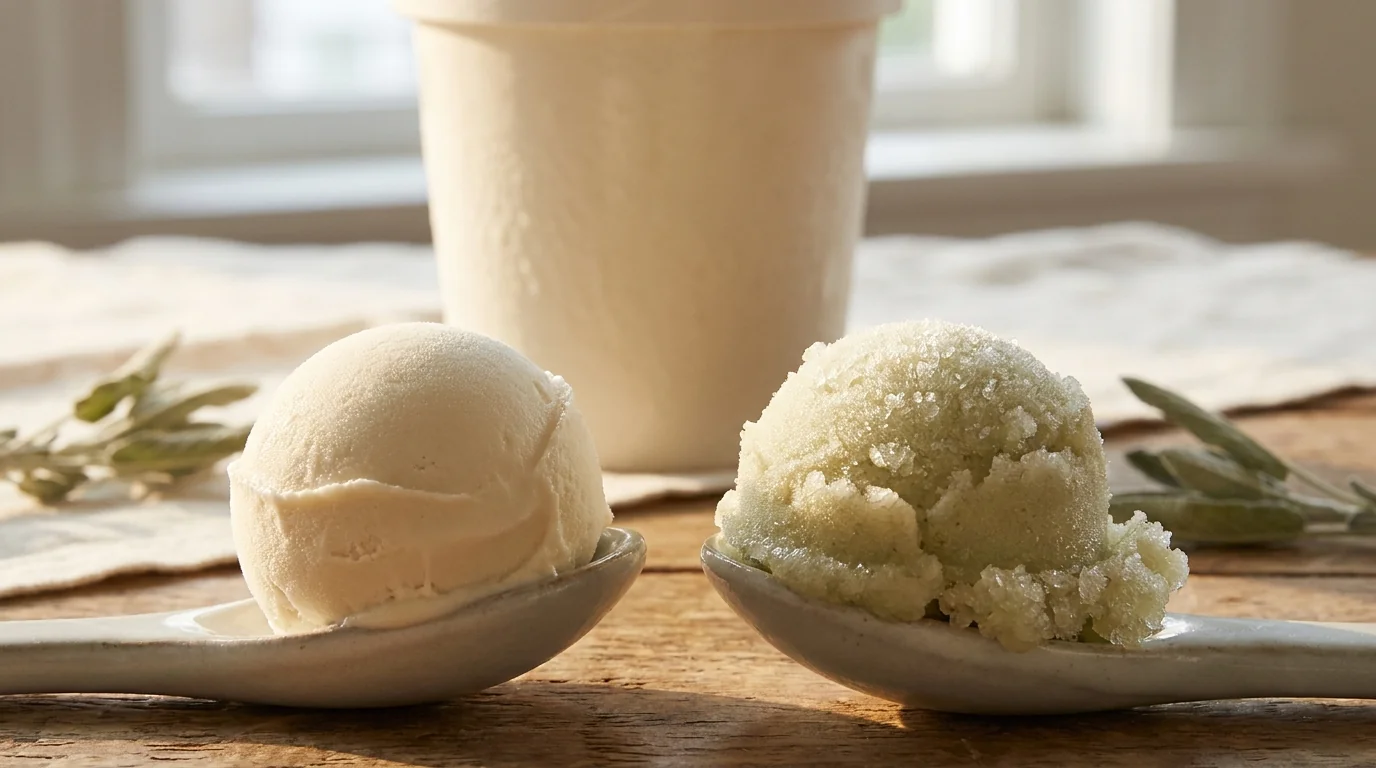
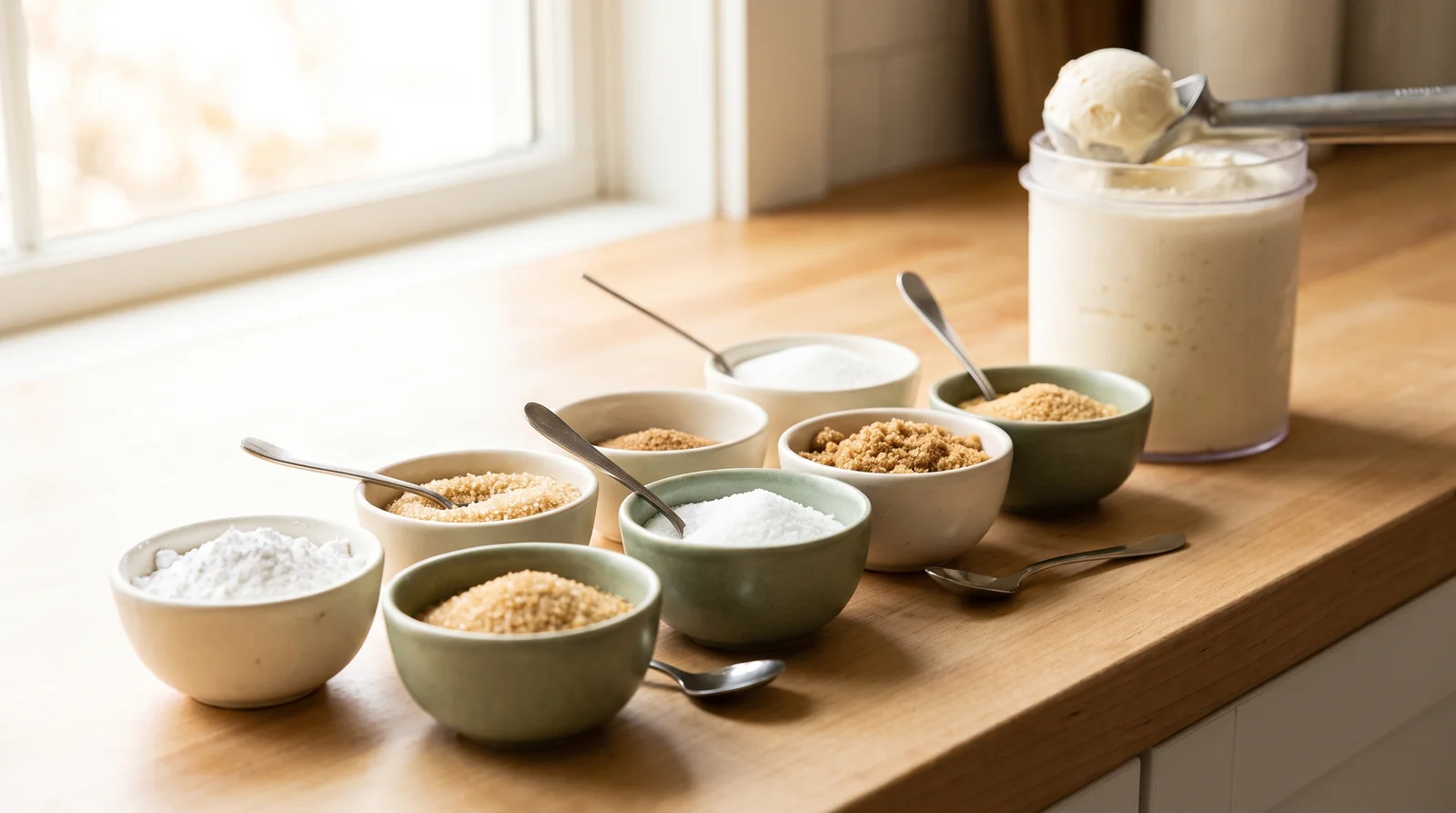
Allulose is the Ninja Creami community's favorite sweetener because it depresses the freezing point of the base almost exactly like sugar, so pints spin soft and stay scoopable. Straight erythritol does the opposite: it recrystallizes as the pint freezes, so erythritol-only bases come out harder and colder than sugar-based ones and usually need a 10 to 15 minute counter thaw plus a respin.
Why your sweetener changes the texture
Ice cream is mostly water, and pure water freezes into large, hard crystals. Anything dissolved in that water gets in the way of crystals forming, which lowers the temperature the base freezes at and keeps part of it unfrozen even in a home freezer. Food scientists call this freezing point depression. In plain words: dissolved sweetener keeps a frozen pint slightly "wet" inside, and that unfrozen fraction is what reads as soft and creamy on the spoon.
Sugar is the baseline. Every traditional ice cream recipe leans on sugar not just for sweetness but for exactly this anti-freeze effect. Swap sugar out for a sweetener that does not dissolve and stay dissolved the same way, and the water in your base freezes harder, the pint turns icy, and the Creami's blade has to fight through it. That is why "which sweetener?" is really a texture question, not a taste question.
The ranked rundown
| Sweetener | Sweetness vs sugar | Freezer behavior | Watch out for |
|---|---|---|---|
| Allulose | About 70% | Freezes soft, very close to sugar | GI upset in larger amounts |
| Sugar | 100% (baseline) | Freezes soft | Adds sugar and carbs |
| Honey / maple syrup | Roughly comparable | Freezes soft | Strong flavor, real sugar, extra water |
| Erythritol / Swerve | About 70% | Freezes HARD on its own | Recrystallizes; needs counter thaw or a blend |
| Monk fruit & stevia blends | Varies by blend | Behaves like the bulking agent (usually erythritol) | Read the label |
| Sucralose / liquid drops | Very sweet, tiny doses | No freezing-point help | Harder pints unless paired with solids |
Allulose: the community favorite
Allulose is a rare sugar that tastes clean, browns like sugar in cooked bases, and, most importantly for the Creami, depresses the freezing point almost exactly the way sugar does. Pints made with allulose scoop soft straight from the machine and refreeze better than pints made with any other zero-sugar option, which is why it dominates r/ninjacreami recommendations. It is about 70% as sweet as sugar, so scale up slightly, and go easy at first: larger amounts can cause GI upset in some people.
Sugar: the baseline that just works
Plain sugar gives the textbook Creami texture, which is no surprise since every classic ice cream formula is built around it. If you are not watching sugar or carbs, it is the simplest answer there is. The obvious trade-off: it adds real sugar and carbs to the pint, which is exactly what most people spinning protein ice cream are trying to avoid.
Honey and maple syrup: soft but loud
Both work well on the freezing-point front and keep pints reasonably soft. Two cautions: their flavor is strong enough to come through in the finished pint (a honey-vanilla is lovely, an accidentally honey-flavored strawberry less so), and as syrups they bring extra free water along with their sugars, so a thin base may want a stabilizer to bind it.
Erythritol and Swerve: the hard-freeze alert
Here is the one that catches everyone. Erythritol is sweet, zero-calorie, and well tolerated in modest amounts, but it does not like staying dissolved. As the pint freezes, straight granular erythritol tends to come back out of solution and recrystallize, so instead of lowering the freezing point it can leave the base freezing harder and colder than sugar would. That is the classic "my sugar-free pint is a hockey puck" story, and stevia-only bases share the problem because stevia adds sweetness without any freezing-point help at all.
If you use erythritol or an erythritol-based blend like Swerve, mitigate: keep the dose modest, dissolve it fully in a warm or well-blended base, let the frozen pint sit on the counter for 10 to 15 minutes before processing, and do not be shy about a respin. Pairing it with a starch-based stabilizer or a spoonful of allulose closes most of the remaining gap.
An honest note on our own products: Simply Desserts mixes are sweetened with erythritol and stevia, and they play by different rules than a scoop of loose granular erythritol. In a pudding mix the dose is small and pre-calibrated (3g of erythritol per serving of Protein Pudding Mix) and it arrives inside a corn starch and emulsifier matrix that binds free water, which is the bigger driver of rock-hard, icy pints. The result is not magic, a no-sugar base will still spin firmer than a full-sugar one, but the counter thaw plus respin routine handles it.
Monk fruit and stevia blends: read the bag
Granular "monk fruit sweetener" or "stevia baking blend" is rarely mostly monk fruit or stevia. Those extracts are hundreds of times sweeter than sugar, so the bag is bulked out with something that pours and measures like sugar, and that bulking agent is usually erythritol. In the freezer, the blend behaves like whatever it is mostly made of. Check the first ingredient: if it says erythritol, apply all the erythritol rules above.
Sucralose and liquid sweeteners: sweetness without softness
Liquid sucralose, stevia drops, and similar high-intensity sweeteners deliver sweetness in drops, which means they add essentially nothing dissolved to the base. Sweet? Yes. Freezing-point help? None. A base sweetened only with drops freezes about as hard as unsweetened milk, so pair them with solids that do the anti-freeze work: allulose, a pudding mix, or simply a richer base with more milk solids.
The blend strategy that actually works
After enough hockey pucks, most of the community lands in the same place: stop asking one sweetener to do everything. The two proven routes are:
Route one: allulose plus a stabilizer. A few tablespoons of allulose for sweetness and softness, plus a small dose of starch-based stabilizer to bind water and slow ice crystal growth. It works, but you are measuring two things and dialing ratios by trial and error.
Route two: a calibrated sugar-free pudding mix, and skip the guesswork. A pudding mix bundles the sweetener, the starch, and the emulsifiers in one pre-dosed scoop. Our pudding mix dosing guide covers exactly how much to use per pint and model. Simply Desserts Instant Puddings are plant-based and dairy-free with 0g added sugar, and the Protein Pudding Mix does the same stabilizing job while adding 5g of protein per serving of mix (20g per box, dairy, made with milk protein).
Whichever route you take, keep the counter-thaw rule: any low-sugar or high-protein pint benefits from 10 to 15 minutes at room temperature before processing, and a respin finishes the job. For the full texture-rescue playbook, start at the Ninja Creami hub.